

The Force weakens
"The Mandalorian and Grogu" shows how Disney treats "Star Wars" as a property, not a beloved story.

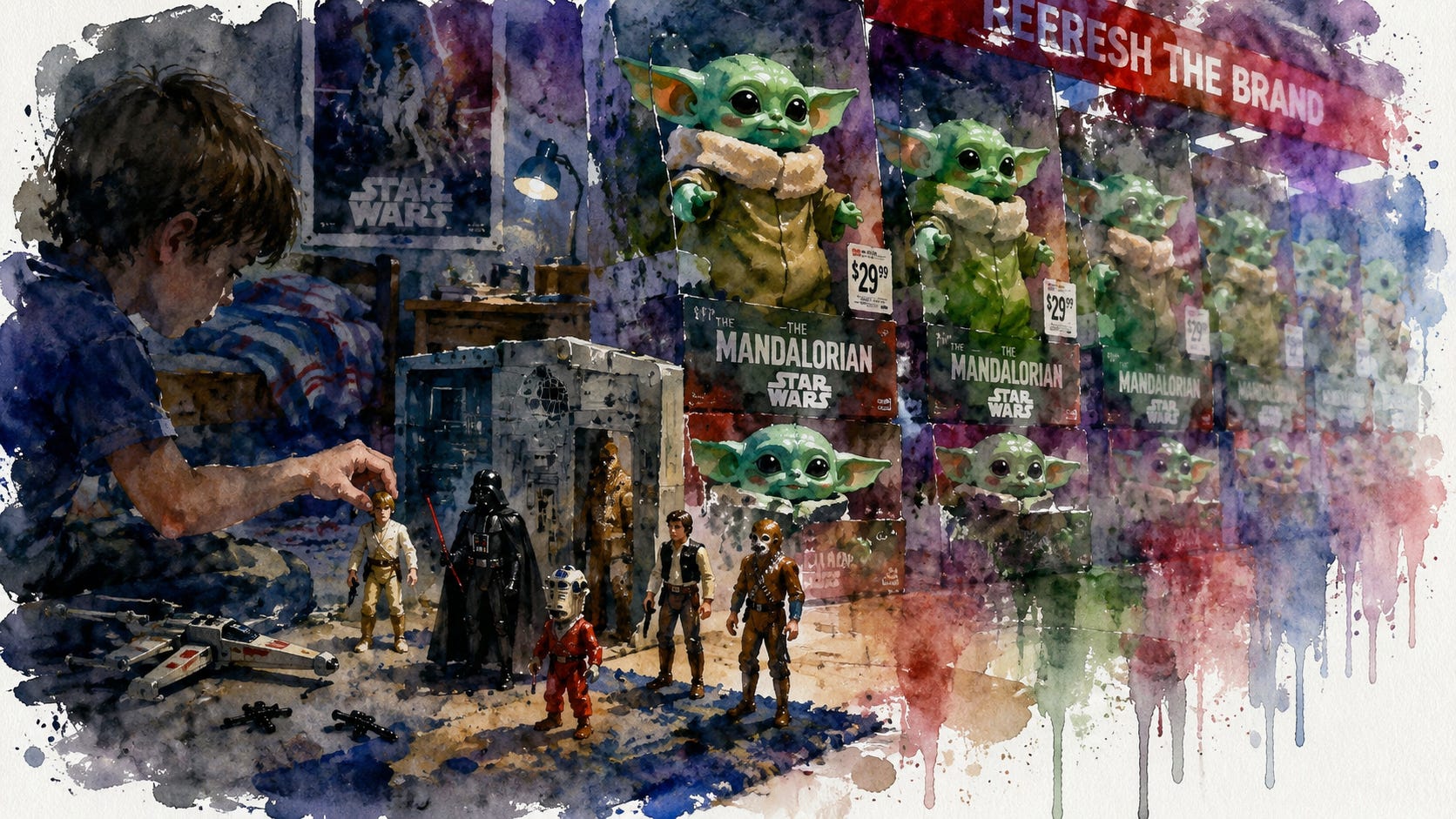
Disclaimer: I admit I am no longer 5 years old.
I will never see a movie with the sense of awe and inspiration that I did when my sister took me to The Empire Strikes Back at the old River Hills Theater north of downtown Des Moines.
Darth Vader terrified me. The good guys lost — hard. The Rebels got routed on the ice planet of Hoth.
Survival was victory — and some just barely. Han Solo got frozen in carbonite. Luke got his hand cut off — and learned Vader was his father.
I note this because I am 50 now and still remember the thrill of seeing Empire in a theater with the big screen, bigger sound, hot popcorn in my lap and a tall pop in my hand.
I’ve seen thousands of movies since then, in the theater, on home video and streaming services. Some of the movies were unquestionably better than Empire in storytelling, performances and technical merit.
Yet I still love Star Wars movies. Sometimes. It’s been a long time since 2016’s Rogue One: A Star Wars Story.
But I did not like — and definitely didn’t love — Star Wars: The Mandalorian and Grogu.
Hard-core Star Wars fans — and I’m friends with many of them — always hit me with the same things: The movies are for kids. I’ve lost my sense of wonder and joy. I’m just like to bash Star Wars.
Those criticisms all have grains of truth, but the one I find most objectionalbe is the idea that of Star Wars is just for children.
Certainly, I whiled away many an hour fighting the forces of good and evil with Kenner Star Wars action figures in the shaggy blue carpet of my bedroom as a boy.
But if they were just for children, why are all those pictures of theaters showing the original film in 1977 filled with people of all ages lined up for blocks to see the surprise blockbuster?
Why did we as fans come back for sequels, prequels, animated series and streaming shows such as The Mandalorian, which spawned the latest film?
We came back because, at least with the original trilogy, there were characters we cared about who grew and changed through the course of the story. The special effects were amazing, but the story and the characters were the juice that took Star Wars to lightspeed.
The Mandalorian streaming series had that for the first two seasons. The lonely bounty hunter takes on the responsibility of fatherhood in a dangerous galaxy with all the bad guys trying to capture the kid formerly known as Baby Yoda.
The story had weight and consequence. Supporting players were as interesting as the main cast from the Kuiil, the gruff Ugnaught mechanic, IG-12, the assassin droid turned protector of Grogu, Carl Weathers’ empathetic border town leader, Timothy Olyphant as sheriff a backwater town wearing Boba Fett’s old armor and Cara Dune, rendered nicely by Gina Carano, as an elite Rebel commando hunting down the destroyers of her native Alderan.
That is a supporting cast. Each character has a rich story that is either told or implied. Their function in the story matters. When they die, it matters.
All The Mandelorian and Grogu offers us is Sigorney Weaver as a weathered Rebel commander who gives Mando bounties in a kind of bored montone that suggests she’s having less fun than the audience.
Martin Scorsese, a George Lucas pal, apparently got a check big enough for him to forget his well-documented distate for blockbuster movies, voicing a CGI-animated food truck vendor that looks like a six-armed monkey.
Then there’s Rotta the Hutt, son of the late Jabba, voiced by Jeremy Allen White, who feels like he’s doing a Paul Shore impression throught the film.
For continuity buffs, Rotta was the Hutt baby Jedis Anikin Skylwaker, Obi-Wan Kenobi and Asoka Tano had to rescue in the first Star Wars dissappointment, the animated Star Wars: The Clone Wars.
There’s Zeb, a furry purple guy, who was in the animated series Rebels. He was based on Ralph McQuarrie’s concept designs for Chewbacca. He is more erriudite then everyone’s favorite walking carpet, but he fills the role of big, strong guy without doing anything interesting.
His only purpose in the movie seems to be brand recognition for completists: Ohhh! I know that guy from this other Star Wars thing I watched! I’m so steeped in the lore, bro!
The supporting characters are flat, uninteresting and if any one of them died, the audience would be overwhelmed with a massive wave of “meh.”
The Mandalorian and Grogu has no stakes. The guy in armor and the puppet are never in real danger. The movie is roughly three forgettable episodes of The Mandelorian streaming series that would be shoved in between episodes that advanced the plot.
This movie has some fun moments, but there are creators using online software to create more interesting stories than what The Mandalorian and Grogu offers.
Blowing up AT-AT walkers on a mountain trail looks cool, but it’s a momentary thrill that adds no momentum to the story. The lack of any real dramatic arc in movie is the rotting zombie heart of Disney Star Wars. Characters are displayed like collectables rather than used to tell a story.
Watching this movie feels like going over to the rich kid’s house and watching him host a tea party with his favorite figures on the Millennium Falcon while you sit there holding a Walrus Man and Snaggletooth with nothing to do but wait until it’s time to go home.
I planned to skip this movie, but it is late in the school year and I’ll do anything to distract myself from the chaos machine that is 12- and 13-year-olds with a week left of class.
Curiosity got the better of me and feeling that pang of loyalty and interest embedded by Empire more than 40 years ago, I went. I should’ve stayed home and played with my old action figures.
I got burned for the umpteenth time by a mediocre product with no connection to the universe I grew up with other than sharing a folder of copyrights and registered trademarks with Luke Skywalker and Darth Vader.
The Mandalorian and Grogu feels more like Star Wars cosplay than actual Star Wars.
In the 1980s, pre-Disney ABC-TV showed two movies based on Ewoks, the teddy bear warriors from Return of the Jedi. Even as a kid, I found these movies lame.
The Mandelorian and Grogu share the same problem with those Ewok made-for-TV movies: The main characters is the film is built around one faceless hero and a space baby who babbles.
I get it. Grogu is cute. He’s been cute since 2019, three seasons of his own show and a few episodes of the abysmal Book of Boba Fett.
Grogu has done a few tricks with the Force, hung out with Luke Skywalker and chose to ride with the Mandalorian rather than become a Jedi.
This isn’t growth. It’s just changing backgrounds in an old side-scrolling video game. It doesn’t matter whether Grogu is in space with Mando or in the jungle with Skywalker. He still presses the same buttons — aw, isn’t he cute? — without accomplishing anything meaningful.
The Mandalorian seems to struggle with his identity in the film, but not in a productive or meaningful way. He’s a killer and his body count is high.
Now he’s working for the New Republic, the government established by the Rebel Alliance after the fall of the Empire.
He’s still killing people — Stormtroopers, space monsters and sundry bad guys.
Yet Mando takes a moment to lecture us on how violence is a last resort. We’ve seen him do nothing but blow people up in increasingly elaborate ways since he was introduced. But, OK, a good man has got to have a code.
Then Mando gets captured by some of Jabba the Hutt’s relatives, who remove his helmet. (Mandalorians are as serious about their hardhats as firefighters.)
Mando’s first move? To threaten to kill them all.
Many times The Mandalorian and Grogu feels like Star Wars iconography pasted on somebody else’s movie.
When Mando and the kid go to a city planet, it looks like the ChatGPT version of the city in Blade Runner.
The winter scene that opens the movie feels like Temu Hoth.
At one point, the Mandalorian is poisoned by a giant, white sewer snake.
Then there’s the wise old dragon thing in the woods who somehow knows Grogu needs something to heal Mando — despite Grogu not being able to, you know, talk — and magically appears to dish out potions and golf tips like some reptilian Bagger Vance.
Borrowing isn’t the problem. Star Wars creator George Lucas borrowed from Kurosawa, westerns, Republic serials and World War II dogfight films.
The difference is Lucas transformed his influences into something energetic and personal. The Mandalorian and Grogu copies other films and calls it innovation.
The primary problem is that the film has no stakes.
The sequel trilogy already tells us that the New Republic fails. That negates Mando and Grogu’s side quests as impactful storytelling territory. Who cares if these bad guys get away? The New Republic is doomed anyway. And Hutts as big bads? Really? A woman in her underwear took out the last one we saw.
And they’re certainly not going to put a blaster bolt in Baby Yoda.
Who cares if either Mando or Grogu live?
Who knows what stage of decomposition the New Republic is in during The Mandalorian and Grogu.
This is the problem with wringing out every last penny from an intellectual property.
Eventually the golden goose stops producing gold and starts laying rotten eggs.
Maybe it feels like I’m unloading the whole hate wagon on a harmless movie.
That’s true. I am frustrated by Disney Star Wars. What the Mouse House has done with Star Wars feels like buying a $4.05-billion mansion, painting it purple and using the pool as an outhouse.
In the 13 years since Disney bought Lucas’ brainchild, they’ve failed to produce a single memorable villain.
I’m told Andor was excellent, but my energy for Star Wars waned as I watched the heroes of my youth vandalized by people who seemed to hate Star Wars.
The Mandalorian streaming series took some of the edge off the sequel trilogy, but today’s creators are copying Star Wars to make more Star Wars.
After enough copies, the original fades and the image blurs.
In the end, this is my fault. I don’t like Disney Star Wars. I’ve known this for years.
But I went to The Mandalorian and Grogu anyway — even though my instincts told me just to let it show up on Disney+ — and then ignore it there, too.
I chose poorly. In doing so, I handed Disney just enough of my own cash to convince them to keep making this dreck.
The goal of modern moviemaking is not critical acclaim (snobs like it), or box office dominance (regular slobs like it).
It’s whether the movie keeps the ecosystem of merchandise, streaming, theme parks, licensing and toys alive and profitable.
This wasn’t a triumphant return to theaters for Star Wars. It was a trade show exhibit.
Corporations lead to greed. Greed leads to formula. Formula leads to emptiness. Emptiness is the path to the Dark Side.
And Disney has been handing out red lightsabers for a long time in that galaxy far, far away.
DANIEL P. FINNEY teaches middle school English. He was a reporter and columnist for the Des Moines Register, Omaha World-Herald, St. Louis Post-Dispatch, and USA Today during a 27-year newspaper career. His column appears in the Indianola Independent Advocate and is distributed by the Iowa Writers Collaborative.